

How to Clean a Hunting Gun: Rifle, Shotgun and Winter Care
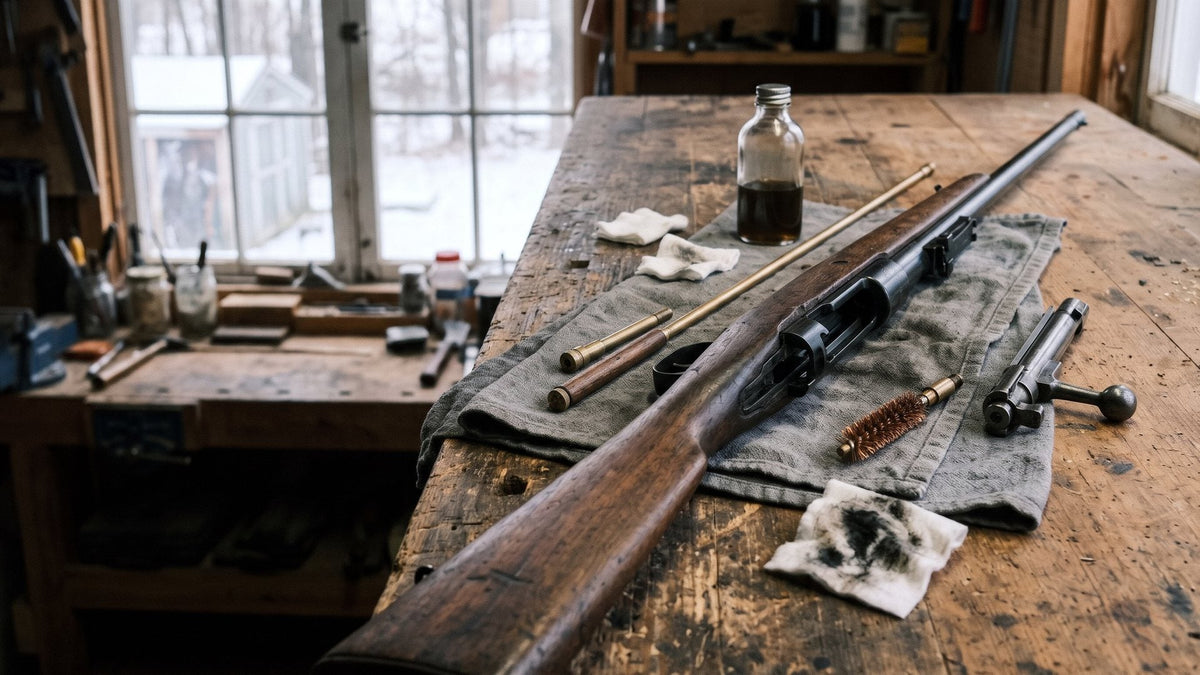
How to clean a hunting gun after a day out: unload it and check it's empty. Push a brush with bore cleaner through the barrel from chamber to muzzle, then patches until they come out clean. Wipe the metal, leave a thin film of oil, and run a dry patch through before your next shot. Everything else is fine print, and that's what the rest of this guide is for: rifles and shotguns separately, copper, chokes, moderators, and what to do when the gun comes home soaked.
TL;DRAfter every hunt a quick job will do: unload, wipe the metal, clean the bore. Give a rifle barrel a proper clean every few dozen rounds. If the gun got wet, dry it first and clean it second. The rod always goes in from the chamber end. Store the gun muzzle down, and never fire with oil left in the barrel.
Safety first
You'll find most of this in any rifle or shotgun manual, and it isn't there for decoration. Browning says outright that many gun accidents happen during cleaning.
- Unload. Open the action and look: nothing in the chamber, nothing in the magazine.
- Take the ammunition out of the room you're cleaning in.
- Keep the muzzle pointed somewhere safe, even when you know the gun is empty.
- Open a window and wear eye protection, because solvent does splash.
- Wash your hands when you're done.
- Strip the gun only as far as its manual allows. A trigger group mostly belongs with a gunsmith.
Camo and special coatings need extra care. Browning warns that chemical damage to those finishes can't be repaired, so keep solvents away from them.
How often to clean a gun
Hunters have argued about this for as long as there have been hunters, and nobody has a single number. This split works in practice:
- After every hunt: the quick job. Wipe the metal, clean the bore with a patch, and take a look.
- After rain, snow or mud: always, and the same day.
- Proper rifle bore clean: sources vary. Beretta Australia suggests every 30 to 40 rounds, while the UK gun shop Bradford Stalker gives its thorough clean for a rifle that has fired 20 or more.
- Full strip of a shotgun: only if you're confident. The ShootingUK writer pulls the ejectors a couple of times a year.
What you need
Everything below is in our gun care and cleaning section.
- Cleaning rod. Get one whose handle turns, so the rod follows the rifling instead of fighting it.
- Bore guide for a rifle. It holds the rod in the middle of the bore and saves your chamber from scrapes.
- Bronze brush in your calibre. A nylon brush handles the lighter jobs.
- Jag and patches, or felt cleaners.
- Bore cleaner. Shoot jacketed bullets? You'll want a copper solvent too.
- Light oil and a clean cloth for wiping down.
- An old toothbrush and cotton buds, because there's always a corner nothing else fits into.
Three kinds of barrel fouling
A barrel isn't simply dirty. Firing leaves different deposits, and each one comes out differently. That's why oil on its own won't get you a truly clean bore.
| Fouling | Where and what it looks like | What removes it |
|---|---|---|
| Powder residue | Black, along the whole bore; the first patch comes out black | Bore cleaner or universal oil with a brush |
| Copper | In rifle bores, from jacketed bullets; the patch goes blue or green with solvent | An ammonia-based solvent. Oil won't touch it |
| Carbon | In the first part of the barrel and as a ring just past the case | Mostly a bronze brush, not chemistry |
Never use a bronze brush with copper solvent or foam. Bradford Stalker warns that those products dissolve the bristles. Ballistol also says its copper solvent Robla Solo MIL contains ammonia and should be kept off brass and copper parts.
Lead bullets leave deposits of their own. Oil alone won't shift them, and Ballistol says Robla Solo MIL removes those too. Read the instructions to see what your own product is meant for.

How to clean a rifle, step by step
We put this order together from Ballistol's and Beretta Australia's guidance. You start at the chamber and work towards the muzzle.
- Unload, take the bolt out, and look through the bore against the light.
- Secure the rifle with the muzzle tilted slightly down, so dirty solvent doesn't run back into the chamber and action.
- Fit a bore guide if one suits your rifle.
- Put oil or bore cleaner on a bronze brush and push it through from the chamber. Don't pull it back until it has fully left the muzzle.
- Push patches or felt cleaners through until they come out nearly white.
- If copper is due, soak a felt cleaner in solvent, push it through, and let it work. Ballistol's tutorial mentions at least 2 minutes, but go by the time printed on your bottle.
- Dry the bore with a patch. Blue means copper's still in there, so go again.
- Push through a felt soaked in oil.
- Wipe the bolt, and scrub the bolt face and under the extractor with a brush.
- Wipe the outside metal with an oily cloth and put the rifle back together.
The chamber
This is the bit everyone forgets. Clean it separately with a short rod and a wool mop in your calibre: in, twist, out. Don't push that mop down the bore.
The moderator
Take the moderator off as soon as you stop shooting, even if the cleaning has to wait. Bradford Stalker warns that leaving it on speeds up bore damage considerably. Corrosive gases and condensation collect inside it. Let it dry before it goes in the cabinet.
How to clean a shotgun, step by step
Most of the job is in the barrels and in the places you don't normally see. ShootingUK lays it out like this:
- Check the gun is empty and break it into three parts: stock and action, fore-end, barrels.
- Take out the chokes if yours are multichoke.
- Clean the bores with bore cleaner and a phosphor bronze brush, let the cleaner work, then pull paper towel through to lift the dirt. Final Rise suggests letting solvent sit for 5 to 10 minutes, but follow the directions on your product.
- Use a small brush along the rib and in the ventilated gaps.
- Clean the action face and the ejector channels where you can reach them. Cotton buds and a toothbrush are ideal.
- Wipe the metal with an oily cloth instead of spraying the gun. Extra oil creeps into the wood, which darkens and weakens it.
- Before you reassemble, oil the metal surfaces that rub against each other.
The forcing cone and plastic wad fouling
The forcing cone is the taper just in front of the chamber, and it's easy to skip. Final Rise warns that skipping the chamber and forcing cone leads to sticky extraction and cycling problems. Plastic wads leave their own residue, and over a season it adds up. Orvis reckons a powder solvent on its own won't touch it, so you'll want one made for wad fouling.
Chokes
Leave chokes in too long and they can bake in so hard you can't get them out. Unscrew them regularly with a choke key, clean off the old grease, clean the threads in the barrel too, and oil the choke before it goes back.

Semi-auto shotguns
Semi-autos have gas ports to think about too. ShootingUK's tip is a toothpick or something like it. As for the rest of the strip, every model's different, so your manual decides.
Pump-action shotguns
Look in the chamber and the magazine tube first. A pump can hide shells in that tube long after you think it's empty. Barrel work is no different from any other shotgun. What's extra is the surfaces the fore-end rides on: wipe them, then give them a touch of oil. Your manual has the last word on anything further.
Quick cleaning: foam and pull-throughs
Both save time. Neither replaces everything above.
Cleaning foam goes into the barrel and expands, so there's no scrubbing. Milfoam Forrest has no ammonia, and Bradford Stalker uses it after a few shots or after each outing. Dry the bore with a patch afterwards, and check the can for the contact time.
A bore cord such as the Bore-Nado packs small enough for the gun slip, so it suits a day in the field or at the range. It gets the worst out straight after shooting, and the proper clean at home is easier for it. Buy the right size for your calibre, because cords have been known to jam in a barrel.
After rain and snow
Trouble with damp usually starts in the car: the gun's in its slip, the lining's wet, and the heater's on.
- Get the gun out of the slip as soon as you can.
- Wipe it with a dry cloth.
- At home, strip it as far as you normally would and dry the places water hides: the rib, the hinge pin and the fore-end iron.
- Let it dry slowly in a warm room. Not next to a stove or radiator, because a wooden stock can crack.
- Dry the slip as well before the gun goes back in.
- Once everything's dry, clean it as usual and leave a thin film of oil.
Condensation forms in winter too, when a cold gun comes into a warm room. Let it reach room temperature before you put it in a bag.
Stock and optics
Stock. Varnish and synthetic are easy: a damp cloth and you're done. An oil-finished stock sometimes wants stock oil. Clean the chequering with a nylon toothbrush.
Optics. Bore cleaner has no business on a lens. Reach for a proper optics cleaner and something soft.
If something's wrong
| What you see | Likely cause | What to do |
|---|---|---|
| Patch comes out blue or green | Copper in the bore | Repeat with copper solvent until there's hardly any colour |
| Patch never comes clean | Carbon, or a cleaner that doesn't suit the fouling | Go again with a bronze brush and bore cleaner, not just oil |
| Rust spot on the metal | Damp, sweat or a wet slip | Wipe it and treat it with oil. If it's in the bore or deep, show a gunsmith |
| Patch or cord stuck in the barrel | Wrong size | Don't fire, don't force it. Take the gun to a gunsmith |
| Choke won't unscrew | Baked-on fouling | Don't force it. Ask a gunsmith |
| First shot after cleaning goes wide | Oil left in the bore | Run a dry patch through before shooting |
Storage and putting a gun away for winter
A clean gun can still rust if you store it badly.
- Muzzle down. Spare oil then runs onto the floor of the cabinet instead of into the action or stock.
- A thin film of oil. A thick coat attracts dirt, and in a barrel it's an obstruction in the bullet's way.
- A dry cabinet. If the room's damp, a room dehumidifier helps.
- End of season: full clean, chokes out, a good look over. Check on it again midwinter.
- Before the next shot: run a dry patch through and look down the barrel to be sure it's clear.
The law matters as well, and if you shoot in Latvia it's changing. Firearms are stored unloaded, and on 27 October the Cabinet of Ministers adopted amendments: for all categories, ammunition must be stored separately from the gun, and in transport it must be packed separately or in a separate compartment of the gun's case. The transition period runs to 1 January 2027. The exact wording is in Regulation No. 210. Elsewhere in Europe, check your own country's rules.
A GunRange look at gun care
Our shop sits under the same roof as the range, so we'll say it plainly: a gun rarely lets you down out of nowhere. Usually someone put something off first. Cleaning isn't a ceremony or a punishment. It's maintenance, the same as sharpening your hunting knife, and all it takes is the right tool for each step and a little time on the evening after the hunt.
Conclusion
Cleaning a hunting gun isn't complicated. Unload, go from chamber to muzzle, don't confuse powder fouling with copper, dry whatever's wet, and store it muzzle down. The rest is habit.
Look after your gun, and it'll look after you when the boar steps out in front of your peg.
Frequently asked questions
Can you use WD-40 to oil a shotgun?
We wouldn't make it your gun oil. It displaces moisture and shifts dirt, and an la.lv article quotes its maker saying it can be used on guns, but we couldn't find a gun maker recommending it. For long storage and for the bore, pick an oil made for guns, and see what your gun's manual says.
Can you overclean a gun?
Yes, but the damage comes from the method and not the habit. Bent rods and poor tools can damage the rifling, the throat and the crown, and so can cleaning from the muzzle end. Done properly, cleaning doesn't hurt a barrel.
How do you clean rust from a rifle?
Start by wiping it, then work oil into light surface rust. An la.lv piece has another route: spray WD-40 on, give it 24 hours, do it again, wipe it off. On gun-owner forums you'll often see bronze wool with oil recommended, and warnings to keep steel wool off bluing. Test the wool somewhere it won't show. Rust inside the bore, or metal that's already pitted, is one for a gunsmith.
What do you need to clean a shotgun?
A cleaning rod with a phosphor bronze brush, a wool mop and a jag, plus bore cleaner and gun oil. The ShootingUK writer also keeps cotton cloths, paper towels and cotton buds handy, plus an old toothbrush and a toothpick.
Should a barrel be dry before you shoot?
Yes, run a dry patch through it. Oil in the bore is an obstruction in the bullet's way, and Bradford Stalker also says a dry bore helps preserve your zero.
From gun oil to cleaning rods, you'll find everything for this job in our gun care and cleaning section.