

How to Zero a Rifle Scope: Step by Step, in Metres and Centimetres
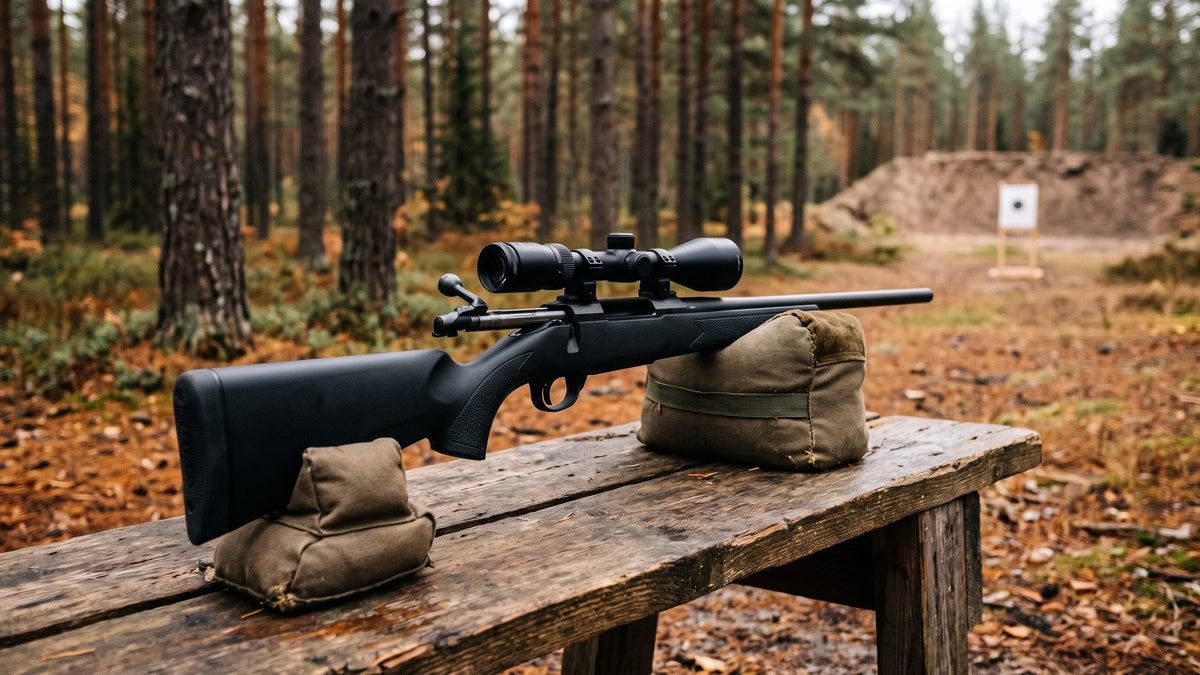
How to zero a rifle scope: tighten the mount, line the scope up with the bore, put three to five shots on paper at 100 m from a solid rest, then see how far the middle of that group landed from where you aimed. That gap becomes clicks. Dial them, shoot again, and look. The rest comes down to patience and knowing what to blame when it goes wrong. You'll find plenty of guides in yards and inches; ours is in metres and centimetres, because that's what we shoot in.
TL;DRBring the ammunition you hunt with. One shot tells you very little, so leave the turrets alone until you can see a group. With 1 cm clicks at 100 m, 8 cm off means 8 clicks. Let the barrel cool for the last group. Hunt with a moderator? Then it stays on for the zero.
Safety first
- A range is the place for this, with a proper backstop behind the paper.
- The range's rules apply to you too, and so do ear and eye protection.
- Looking through the bore? Unload first, pull the bolt and see for yourself that the chamber's empty.
- A cartridge-style laser comes out of the chamber before any live round goes near the rifle. It must never be left in the gun.
What zeroing is, and when to do it again
You're teaching the scope where the bullet really goes, so that at a distance you've picked, crosshair and hole agree. They won't agree everywhere: the scope rides above the bore and the bullet travels in an arc.
Go back to the range after a new scope or mount, a change of ammunition, a fall or a hard knock, or a moderator going on or off. Do it before the season too, and after any miss in the field you can't explain.
That last one matters. In a case told on Medibam.lv, a hunter with a night scope missed six times, and the range then showed the rifle hitting half a metre to the right. One unexplained miss is reason enough for a trip to the range.
Before the first shot
Plenty of zeroing trouble starts at home, so look at four things before you leave.
- Mount. Tighten the scope mount screws to the maker's figure. Too loose and recoil walks the scope out of zero. Too tight and you can crush the tube.
- Eye relief and reticle. Set the scope so you see the full picture, then check the reticle isn't tilted.
- Bore. Clean and free of oil. We have a separate guide to cleaning a hunting gun.
- Ammunition. Bring the same lot you hunt with. A group from some other box tells you nothing about your zero.
What distance to zero at
The usual distance is 100 m. The real choice is whether to hit dead on or slightly high.
| Zero | Where it hits at 100 m | When it suits |
|---|---|---|
| Dead on | Where the crosshair sits | The simple choice if you shoot at about that range or know your bullet's drop |
| 4 cm high | About 4 cm above the aiming point | If you often shoot further. Germans call it GEE, and Hubertus Fieldsports says it takes you to about 200 m with little hold change |
That 200 m is no promise, though. Calibre and load decide the real curve, so look up your ammunition maker's ballistic table and try it on the range if you get the chance.

How to zero a rifle scope, step by step
- Bore sight it. On a bolt-action, take the bolt out, secure the rifle and look through the bore from 60 to 80 cm away. With the target centred in the bore, and without moving the rifle, use the turrets to bring the crosshair onto the same spot.
- Can't see through the bore? Use a laser bore sight. We carry cartridge-style ones in calibres such as 7x64, 8x57 IRS, 9.3x62, 6.5x55 and .308 Win. It gets you on paper. It doesn't replace shooting.
- Get a solid rest. Support the stock and fore-end, never the barrel. A shooting rest or sandbags will do.
- Unsure of the first shot? Start closer. A shot at about 25 m shows whether you'll hit paper at all. The impact won't match 100 m yet, so finish the job at 100 m.
- Fire a group. Five shots at one aiming point is ideal, three the bare minimum. There's no prize for speed.
- Find the centre. Hubertus takes the midpoint of the two holes furthest apart. A lone flyer proves nothing.
- Measure and dial. Take height and sideways error separately, then work out the clicks using the table below.
- Check with a fresh group. Correct again if you need to, but don't make a big change on the strength of one shot.
- Finish with a cool barrel. The first shot is usually the one that counts on a hunt, so that's what your last group should reflect.
- Mark your zero. Some turrets let you slip the scale back to zero. If yours does, do it, and you'll always find your way home.

Scope clicks in centimetres
Start by finding what one click is worth. It's usually printed on the turret or in the manual. Hubertus Fieldsports says most scopes move 1 cm per click at 100 m.
Say the centre of the group is 8 cm right and 5 cm low. The impact has to come left and up.
| One click | Moves impact at 100 m | 8 cm left | 5 cm up |
|---|---|---|---|
| 1 cm or 0.1 mrad | 1 cm | 8 clicks | 5 clicks |
| 1/4 MOA | 7.3 mm | 11 clicks | 7 clicks |
| 1/8 MOA | 3.6 mm | 22 clicks | 14 clicks |
The sum is simply the error divided by the click value.
Halve the distance and each click halves too. Shooting at 50 m, that 1 cm click shifts the hole just 0.5 cm, which is why 4 cm off needs 8 clicks there rather than 4.
Go by what's written on the turret. "Up" or "right" normally moves the impact that way, but makers differ, and habit from your last scope won't help.
MOA vs mil, in plain terms
Both are angles. They describe how far the impact moves, and the further the target, the more it moves.
- 1 mil (or mrad) is 10 cm at 100 m. The usual click is 0.1 mrad, which makes 1 cm.
- 1 MOA is about 2.9 cm at 100 m. The usual click is 1/4 MOA, which makes about 7 mm.
Neither gives you a better zero by itself. If you think in metric, mil makes the sums easier, though an MOA scope works just as well once you know its click value. If you're choosing a new riflescope, the thing to look for is a reticle and turrets that use the same unit.
Magnification and wind
Magnification. County Deer Stalking sets 6 to 8 power at most for a zero, then leaves the dial alone. Zooming shouldn't shift the impact on a quality scope, according to The Everyday Marksman, and if yours does, it wants repairing. So once you've got your zero, try a shot at the power you hunt on. Second focal plane scopes have one more catch: Sightmark says their reticle marks only read true at one magnification, so check your manual for which one.
Wind. County Deer Stalking's ideal day is dry with hardly any wind. The Everyday Marksman ranks wind as the biggest weather factor and warns that a zero set in a blow may not hold on a calm day. Stuck with a windy day? Recheck when it settles. It's worth a quick confirmation at the start of every session anyway.
How good should the group be?
For a hunting rifle, Hubertus Fieldsports puts the limit at 5 cm at 100 m and calls 20 to 30 mm good. It also warns that spread often roughly doubles in real hunting conditions.
A wide group isn't a scope-setting problem, and no amount of turret work will tighten it. Check the mount, the rest, the ammunition and your own shooting first. Centre the group afterwards.
Hot barrels, clean barrels and moderators
Heat. A barrel can shift its point of impact as it warms up, thin barrels and big cartridges especially. Outdoor Life suggests at least a minute between shots and a full cool-down before the final check. Hubertus says a free-floating barrel can be fired more quickly, but a combination gun with soldered barrels needs about 10 minutes between shots. If in doubt, slow down.
Freshly cleaned bores. A spotless barrel can shoot differently from a fouled one. Outdoor Life advises two or three fouling shots after cleaning, before you do any final zeroing.
Moderators. Screw one on and the rifle will usually hit somewhere else, so zero the way you hunt. Take it off and things can move again. Use it both ways? Then you've got two zeros to check.
Why your scope won't zero
| Symptom | Likely cause | What to do |
|---|---|---|
| Nothing on the paper | Scope and bore aren't aligned | Bore sight again and start closer |
| You dial and nothing happens, then the group jumps | The scope's internal mechanism has stuck | Fire two more shots. Outdoor Life suggests tapping the turret cap gently, or dialling one full turn past and back |
| Impact moves the wrong way | Turret turned the wrong way, or scope mounted upside down | Read the turret markings and check the elevation turret is on top |
| Clicks move the impact half or double what you expected | Wrong click value or a miscount | Recheck the value and the sum, then fire a new group |
| Group wanders as the barrel heats | Barrel temperature | Let it cool between shots |
| Impact changed after cleaning | Clean bore or oil in the bore | Run a dry patch through, fire two or three shots and check |
| Hits on the range, misses in the field | Different rest, or different pressure on it | Check your impact from the support you hunt with |
After you've zeroed
A range bench isn't a hunting day. Hubertus recommends practising from standing and prone afterwards, and Outdoor Life notes that hard and soft rests can move the impact. So fire a few shots from the shooting sticks you actually carry.
Jot down the load, the distance and where the turrets sit. Next autumn, when the rifle hits somewhere odd, you'll know what changed.
The GunRange view on zeroing
Our shop sits under the same roof as a shooting range, so we'll say this plainly: a good zero isn't one lucky shot. It's a group you can repeat with the ammunition you really hunt with. A box of cartridges and an hour on the range is a small price for a clean shot and for not leaving an animal wounded.
Final thoughts
Tighten the mount, line up scope and bore, shoot groups rather than single shots, measure in centimetres and turn it into clicks. Then check it once more through a cool barrel.
Measure twice on the range, shoot once in the forest.
FAQ
What distance should I sight my rifle in at?
Usually 100 m, either dead on or about 4 cm high if you often shoot further. Your ammunition's ballistic table will give you the exact picture. If you're not sure of hitting paper, start closer and finish at 100 m.
Which way do I turn the scope to sight in?
Turn it in the direction you want the impact to move, as marked on the turret. If the group is low, dial "up"; if it's to the right, dial "left". Makers mark turrets differently, so read yours.
Why is my scope not sighting in?
The usual suspects are a loose mount, an unsteady rest, mixed ammunition or a wide group. Now and then the scope's mechanism sticks. Go through those before you blame the scope itself.
How many shots does it take to zero a rifle?
Vortex describes a three-shot method for a well bore-sighted rifle, though it relies on no shot being a fluke. The Everyday Marksman reckons on about 20. Bring at least a full box and take your time.
Do I need to zero again for different ammunition?
Yes. A different bullet, weight or even brand can land somewhere else. Whenever you change ammunition, check it on the range before you hunt with it.
If you're looking for a new scope, have a look through our riflescopes.