

How to Choose Winter Hunting Boots: High Seat, Driven Hunt or Wet Ground
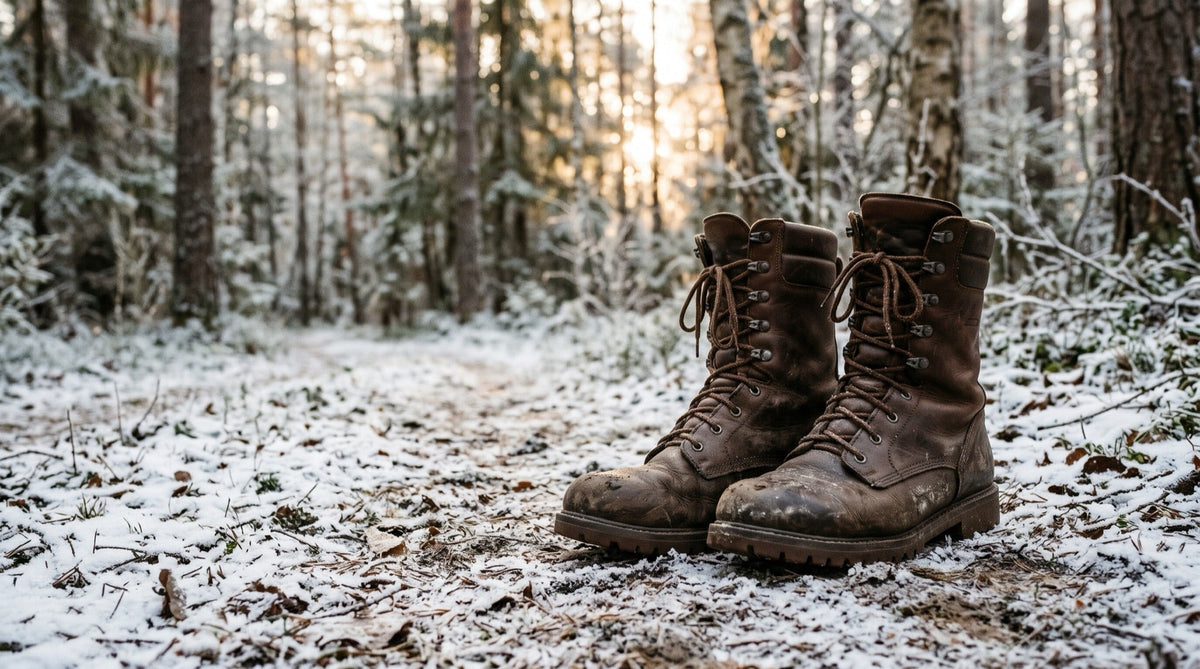
How to choose winter hunting boots comes down to one question: how much will you move? If you sit in a high seat for hours, you want a thermo boot with a removable inner boot, or a lambskin-lined boot, bought with room for your toes. If you walk, as on a driven hunt or a stalk, you want an insulated leather boot with a waterproof membrane. If the ground is wet, you want rubber with a neoprene lining. Add wool socks and you've done most of the work. All four types are in our hunting boots section, and below we explain which one suits which hunt.
TL;DRSitting still needs more insulation than walking, and the cold comes up from the floor. A boot that's too tight is a cold boot. Sweat from the walk in is what freezes your feet later, so manage moisture as well as warmth. No cotton socks. The live price of every boot below is on its product page.
Why your feet get cold
Before you spend money on boots, it helps to know what you're fighting. Feet get cold for four reasons, and only one of them is "the boot isn't warm enough".
- You stop moving. Field & Stream's cold-weather boot test puts it simply: when you sit idle in the cold, blood flow to your extremities slows. A boot that's fine on a walk can be cold in a high seat.
- You sweated on the way in. A brisk walk to the seat with a rucksack makes your feet damp, and damp feet cool fast once you sit down.
- Cold comes from below. A cold high-seat floor, or ice, pulls heat out through the sole. In OUTDOOR magazine's 2014 winter boot test, cold reached the forefoot of the weaker boots on ice in about 15 minutes. The best one held out for nearly an hour.
- The boot is too tight. Squeezed feet get less blood, and there's no trapped air to keep warm. Outdoor Life makes the same point: boots that are too tight reduce warmth.
Each of these has a fix, and most of the fixes are about choosing the right type of boot for how you hunt.
Four types of winter hunting boot
| Type | Best for | Warmth | Weak point |
|---|---|---|---|
| Thermo boot with a removable inner boot (Canada style) | Long nights in the high seat, deep frost | Highest | Bulky and heavy for walking |
| Lambskin or felt-lined leather boot | Sitting still, dry snow | High, and breathes well | Heavy, expensive, not for deep wet ground |
| Insulated leather boot with a membrane | Driven hunts, stalking, walking to the seat | Medium to high | Less warm than a thermo boot when you sit for hours |
| Rubber boot with neoprene lining | Wet ground, bogs, thaw | Medium | Doesn't breathe, so feet sweat |
A leather boot with a membrane but no insulation is an autumn boot. It's fine for active days down to around freezing with good wool socks, but don't expect it to keep you warm in a high seat in January.
How high should the boots be? Ankle boots suit dry ground and autumn, calf height (about 20 to 30 cm) suits snow and mud, and knee-high rubber suits bog and deep water. Hunter-Ed's guide splits them the same way. Weight matters too: heavier boots carry more insulation but tire you on a long walk. A pair of Baffin Thermosdeep Apex weighs about 3.5 kg, a pair of KAMIK ThermosForest2 about 1.6 kg.
Boots for the high seat
This is where people get cold, and where boot choice matters most. You'll be still for hours, often on a cold floor, so you need plenty of insulation underfoot and around the toes.
Field & Stream suggests at least 1,200 g of insulation if you're sitting, against 600 to 1,000 g if you're moving. Most European thermo boots don't quote grams. They use thick inner boots or lambskin instead, so look at what's under your foot and whether the liner comes out.
What to look for:
- A removable inner boot. You can dry it overnight, and it adds a layer under your foot.
- A thick insole or felt footbed between you and the floor.
- A roomy fit, so you can wiggle your toes in thick socks.
A trick that works: walk to the seat in lighter boots and change into the thermo boots once you're up, or carry them in the rucksack. If you can't, loosen the laces when you sit down, so blood moves freely.
For very long, very cold nights, heated socks are worth considering. More on those in the socks section.

Boots for driven hunts
On a driven hunt you stand at your place on the line for an hour or more, then walk to the next drive, often across fields, ditches and frozen ruts. You need a boot that's warm enough to stand in and stable enough to walk in.
An insulated leather boot with a Gore-Tex, Sympatex or similar membrane does both. Look for:
- Insulation, either in grams (Hanwag's Alaska Winter has 400 g) or a lined membrane such as Gore-Tex Insulated Comfort. Field & Stream's figures are higher, 600 to 1,000 g for moving, but they test for North American cold.
- A winter sole that grips on ice. Hanwag's IceGrip, Vibram's Arctic Grip and Meindl's Multigrip ROCK all use special rubber or particles for frozen ground.
- A higher shaft, around 20 cm or more, to keep snow out and support your ankle.
- Quiet uppers. Supple leather makes less noise than stiff synthetics when you shift your weight.
Wet ground, bogs and thaw
A Latvian winter is often wet rather than frozen. When you're crossing wet meadows or bog, or there's slush on the ground, rubber beats leather because nothing gets through it. A neoprene lining adds insulation. Parforce's lined boots use 4 mm, which the maker says is warm enough for sitting at low temperatures.
The catch is that rubber doesn't breathe. Feet sweat, and the sweat stays inside. Take the insole out and dry the boots every evening, and wear wool socks that stay warm when damp. A side zip makes the boots easier to get on and lets you tuck your trousers in.
A plain rubber boot with a thin jersey lining is a summer and autumn boot, not a winter one.
Getting the size right
Most cold-feet problems start in the shop, with a boot that fits like a summer boot.
- Try boots on in the afternoon, when your feet are slightly swollen, and wear the socks you'll hunt in.
- Leave room for your toes. You should be able to slide a finger behind your heel with the boot unlaced and your toes touching the front.
- Follow the maker's sizing note. Baffin, for example, recommends going one size up on its thermo boots for heat circulation. Others size normally, so read the product page.
- Women's and wide fits exist. A women's last is usually narrower at the heel. A wide last, like the Hanwag Alaska Wide, gives the forefoot more room, which also helps warmth.
- Check there's space for your own insole if you use an orthopaedic one. Most good boots have a removable insole for exactly that.
- Break them in before the season. Wear new boots around the house and on a few walks first, so your first long day out doesn't end in blisters. Both Hillman and Hunter-Ed give the same advice.
Socks
Socks matter as much as boots, and they're cheaper to get right.
- Wool, never cotton. Cotton holds sweat and goes cold. Merino and wool blends stay warm when damp.
- One good thick pair beats two tight ones. Two pairs only work if the boot has room for them. Otherwise you've made the boot too tight.
- For long sits, Outdoor Life suggests a thin liner sock under a heavyweight wool sock.
- Bring a spare pair and change at the seat if your feet got damp on the way.
Woolpower's terry-knit Classic 400 socks and the knee-high 600s are made for exactly this. For the coldest nights, heated socks like the Lenz Toe Cap models put heat over the toes, where you lose it first. Know their limits: a 2025 Velomotion test of the Lenz 5.1 praised the build quality but found the heat output modest, and the battery packs are sold separately.
Membranes and insulation, in plain words
- Membrane (Gore-Tex, Sympatex, Comfortex): a thin waterproof layer inside the boot that lets sweat vapour out. It keeps water out, but it doesn't make the boot warm.
- Gore-Tex Insulated Comfort: a Gore-Tex membrane with an insulating lining built in. You'll find it in winter boots like the Meindl Kibo and Narvik.
- Grams (200 g, 400 g, 1,000 g): the weight of synthetic insulation per square metre. More grams means warmer, but also bulkier. Hanwag's Alaska Winter uses 400 g of G-LOFT.
- Lambskin: natural fleece left on the leather. It's very warm, it breathes, and Meindl points out it absorbs moisture without feeling damp.
- Inner boot: a removable felt or multi-layer liner, typical of Canada-style thermo boots. Take it out and dry it after every outing.
Winter boot care

- Take out the insoles and inner boots after every hunt and let them dry separately.
- Dry slowly, at room temperature, stuffed with newspaper if they're soaked. Keep them away from radiators and stoves, because heat cracks leather and can damage the glue in the sole.
- Treat the leather with wax or a care spray once the boots are dry, so it keeps shedding water.
- Rinse salt and mud off after road walks and field edges.
- Store dry, not in a cold car.
What we'd pick
We're not a test lab, so where a respected publication has tested a boot we sell, we say so. Where nobody has, we tell you why it's on the list. Prices are approximate. Our prices follow our supplier's, so they move, and if you find a boot cheaper than quoted here, that's a sale.
For driven hunts and stalking
- MEINDL Kibo GTX, around €460. A tall, insulated winter hunting boot with a Gore-Tex Insulated Comfort bootie and an ice-grip sole. Petersen's Hunting wore the US version, the Kibo GTX Hunter 600, for two years, including deep snow on an ibex hunt, and called it "a great choice".
- Hanwag Alaska Winter GTX, around €350. 400 g G-LOFT insulation and Hanwag's IceGrip sole. It was OUTDOOR magazine's test winner for warmth and wet protection. That was a hiking magazine test from 2016, not a hunting one, so treat it as a strong hint rather than the last word.
- Parforce Active Winter, around €140. Our value pick: a lined leather boot with a Comfortex membrane and a Vibram Arctic Grip sole.
For the high seat
- Baffin Control Max, around €440. A Thermaplush inner boot and a polar rubber sole. In OUTDOOR magazine's 2014 winter boot test, Baffin's two boots, the Control Max among them, insulated best of 13, and the testers recommended them for long periods standing in the cold.
- KAMIK ThermosForest2, around €120. Also in a women's version. Our budget pick for the seat: an 8 mm removable inner boot with another 8 mm under the foot, and one of the lightest Canada boots around, at about 1,600 g a pair. No magazine test that we could find, so this one is on its specs.
- Hanwag Grizzly Top, around €720. The buy-once option: 8 to 10 mm of lambskin right to the toe, double-stitched, with a side zip. Again, no editorial test, but it's built the way traditional winter hunting boots always were.
For wet ground
- Parforce rubber boots with zip and neoprene lining, around €145. Natural rubber made in Europe, a 4 mm neoprene lining and a side zip. Parforce says they're warm enough for sitting at low temperatures.
Socks
- Woolpower Classic 400, around €27, and Woolpower Knee high 600, around €40, for the high seat.
Conclusion
Start from how you hunt, not from the brand. Sitting still needs a thermo or lambskin boot, a size with room in it and a thick floor under your feet. Walking needs insulated leather with a winter sole. Wet ground needs neoprene rubber. Wear wool socks, keep a dry pair in your pocket, and dry everything properly between hunts. Warm feet keep you in the seat longer, and the longer you sit, the better your chances.
FAQ
What are the warmest boots for hunting?
Thermo boots with a thick removable inner boot, and lambskin-lined boots, are the warmest for sitting still. In OUTDOOR magazine's 2014 test, the two Baffin boots insulated best of 13.
Are Gore-Tex boots good for winter?
Only if they're insulated. Gore-Tex keeps water out, but it doesn't add warmth by itself. Look for an insulated version, such as Gore-Tex Insulated Comfort, or for insulation in grams.
What size winter hunting boots should I buy?
Big enough to wiggle your toes in your hunting socks. Many thermo boots, such as Baffin, are meant to be bought a size up. Others fit true to size, so check the maker's note on the product page.
What's the difference between 400 g and 800 g insulation?
According to Hunter-Ed's guide, 400 g suits active hunting and cool weather, 800 g moderate cold, and 1,200 g or more long sits in hard frost. More grams also means a bulkier, heavier boot, so choose by how much you'll move.
Are rubber boots OK for winter hunting?
Yes, if they have a neoprene lining and the ground is wet. Plain rubber boots with a thin lining are too cold for a winter high seat.
All our hunting footwear is in the hunting boots collection. We deliver across Europe for €10, or you can collect your order free at our range in Riga.